
Polymorph-Induced Reducibility and Electron Trapping Energetics of Nb and W Dopants in TiO2
Published in The Journal of Physical Chemistry C, 2025
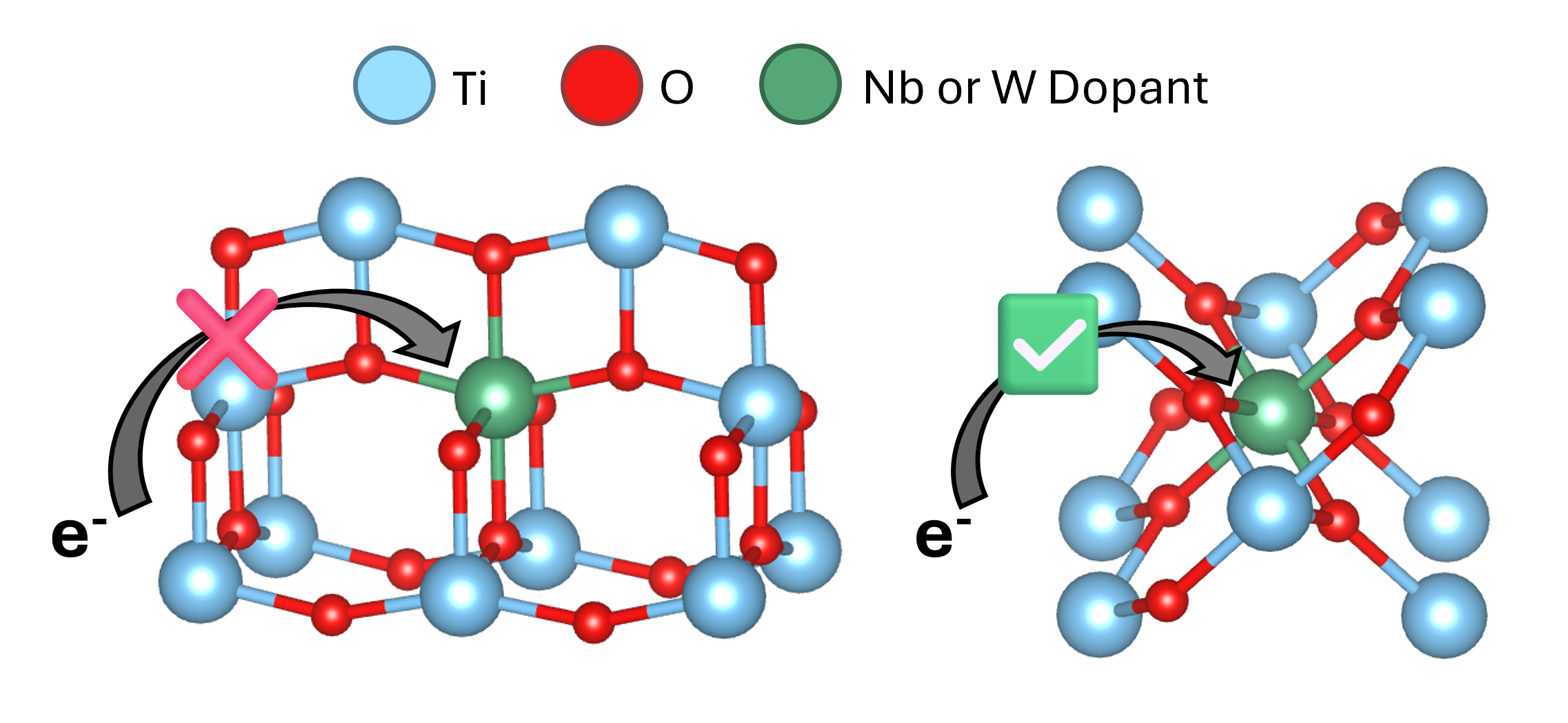
Abstract
Controlling the formation of electron polarons in TiO2 doped with transition metals is important for the design of transparent conducting oxides for high-efficiency photovoltaics and photocatalysts with tuneable reaction selectivities. In this work, EPR spectroscopy is combined with Hubbard-corrected density functional theory (DFT+U), using refined atomic-like Hubbard projectors, to show the sensitivity of charge compensation in substitutionally doped Nb–TiO2 and W–TiO2 with respect to the TiO2 polymorph (i.e., anatase or rutile). Both EPR magnetic tensors and DFT+U predicted Nb 4d and W 5d orbital occupancies show the formation of differing dopant charge states depending on the TiO2 polymorph, with non-magnetic Nb5+ and W6+ in doped anatase, and paramagnetic Nb4+ and W5+ in doped rutile. The results demonstrate how a coherent experiment-and-theory-validated framework can be used to understand and predict the reducibility of dopants and electron-trapping energetics in TiO2 polymorphs. The outcome enables greater control over the electronic and magnetic properties of metal-oxide semiconductors, which is crucial for the rational design of next-generation materials for energy-conversion and catalytic applications.
Citation: A. Chaudhari, A. J. Logsdail and A. Folli, Polymorph-Induced Reducibility and Electron Trapping Energetics of Nb and W Dopants in TiO2, The Journal of Physical Chemistry C, 2025, 129 (34), 15453-15461, DOI: 10.1021/acs.jpcc.5c04364