
Ab Initio Insights into Support-Induced Sulfur Resistance of Ni-Based Reforming Catalysts
Published in Catalysis Science & Technology, 2026
Abstract
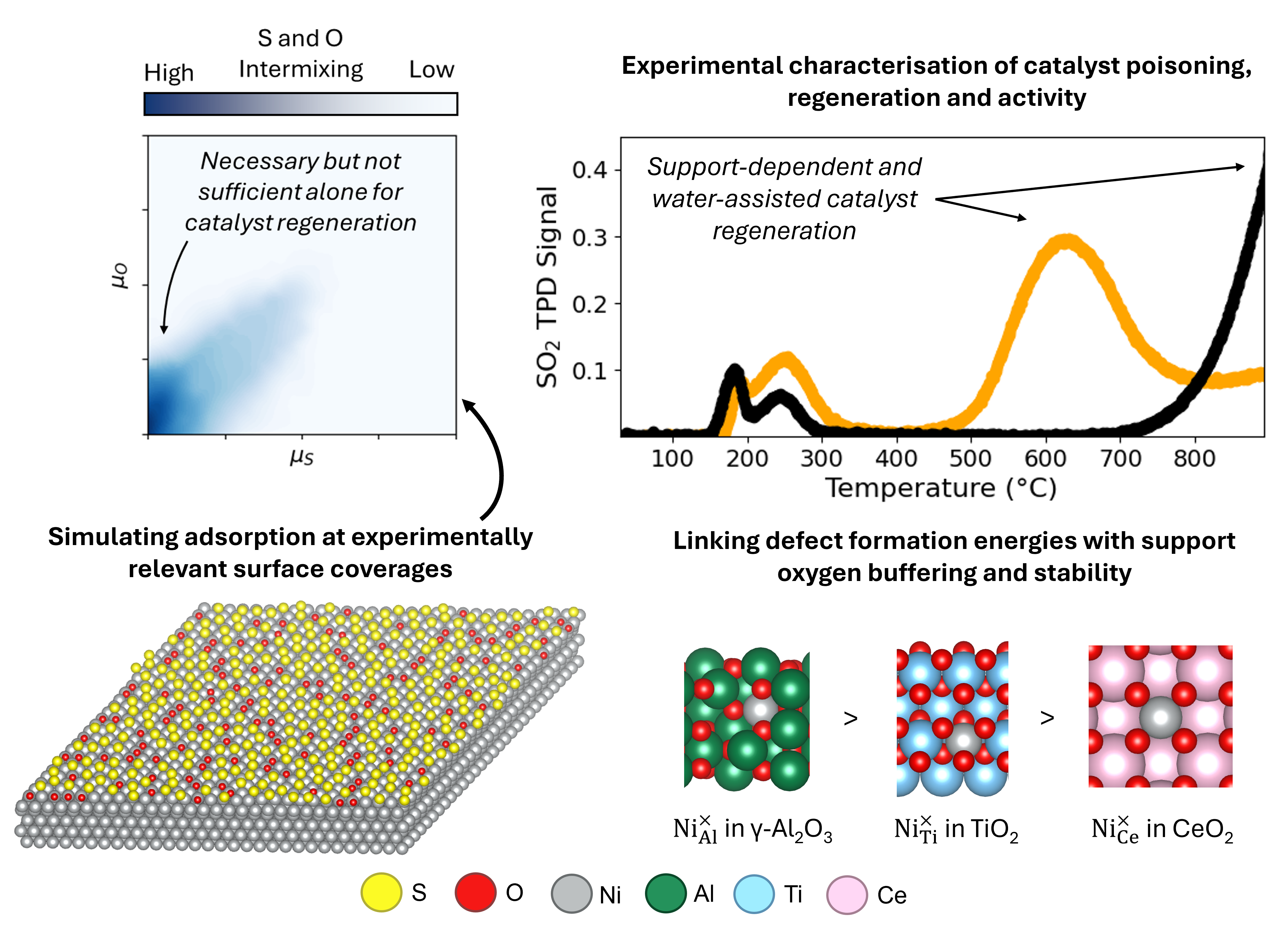
Ni-based catalysts are well established for industrial H2 production via methane steam reforming; however, their susceptibility to sulfur poisoning necessitates expensive desulfurisation and limits the development of low-temperature processes using renewable feedstocks. Designing next-generation catalysts requires an atomic-level understanding of the factors that affect the catalyst sulfur tolerance, but this is difficult to obtain due to complex interactions between the Ni catalyst and non-inert metal oxide supports. In this work, a combined computational and experimental approach is adopted to investigate design strategies for enhancing the sulfur tolerance of Ni catalysts via optimisation of the metal oxide support. We investigate the thermodynamic driving force for oxygen-mediated sulfur removal from the Ni(111) surface, which is indicative of the regenerative effects of support oxygen buffering, using grand canonical Monte Carlo (GCMC) sampling of a lattice model parameterised using density functional theory (DFT). The outcome is predictions of the surface coverage and composition of adsorbed S and O atoms across an extended Ni(111) surface, validated with a fine-tuned machine-learned interatomic potential to reveal entropic contributions to catalyst regeneration at experimentally relevant surface coverages. Simulations of the surface chemistry of Ni(111) are complemented by predictions of the energetics of bulk defect formation in prototypical metal oxide support materials, providing insights into the proclivity for oxygen release and phase transformation during catalytic reactions. The computational modelling is correlated with experimental characterisation and methane steam reforming activity tests for H2S-poisoned Ni nanoparticle catalysts, allowing us to rationalise the experimentally observed differences in catalyst sulfur tolerance and establish strategies for future catalyst optimisation. Overall, the work demonstrates the integration of ab initio computational modelling, statistical sampling, and machine learning in a unified framework that complements experimental characterisation to inform the rational design of catalyst support materials for sustainable H2 production.
Citation: A. Chaudhari, P. Stishenko, A. Hiregange, C. Hawkins, M. Sarwar, S. Poulston and A. J. Logsdail, Ab Initio Insights into Support-Induced Sulfur Resistance of Ni-Based Reforming Catalysts, Catalysis Science & Technology, 2026, DOI: 10.1039/D5CY01279A